
Dührssen-Schuchardt colpoperineotomy for vaginal hysterectomy in an extremely overweight patient
Authors:
D. Habek 1-3

Authors place of work:
Department of Gynecology and Obstetrics, Clinical Hospital Merkur, Zagreb, Croatia
1; School of Medicine, Catholic University of Croatia, Zagreb, Croatia
2; Croatian Academy of Medical Sciences, Zagreb, Croatia
3
Published in the journal:
Ceska Gynekol 2026; 91(4): 347-349
doi:
https://doi.org/10.48095/cccg2026347
Summary
Objective: Dührssen-Schuchardt incision is an extended vaginoperineal, deep lateral incision of the vagina, paracolpium, levator ani, and perineum represented by the expansion of the operating field during vaginal hysterectomy. Materials and methods: In 21 extremely overweight patients with premalignant (11) and malignant endometrial disease FIGO IA (10) and policomorbidities, total vaginal hysterectomy with a unilateral Dührssen-Schuchardt incision was performed. It was impossible to perform a laparotomic or laparoscopic procedure in any of the patients due to the mentioned comorbidities and polycomorbidities. Results: There were no postoperative complications related to the surgical procedure and the surgical wound; all wounds healed per primam, and no late postoperative complications related to the surgical technique were recorded. Conclusion: Therefore, this approach to total vaginal hysterectomy with the help of a Dührssen-Schuchardt incision is certainly a “minimally invasive procedure.”
Keywords:
obesity – vaginal hysterectomy – Dührssen – Schuchardt
Introduction
The Dührssen-Schuchardt incision (DSI) is an extended vaginoperineal, deep lateral incision of the vagina, paracolpium, levator ani, and perineum (colpoperineotomy, episiotomy profunda, extended perineotomy) that was primarily used in total vaginal hysterectomy (TVH) and obstetric operations (vacuum extraction, forceps). Women with extremely overweight have a significant clinical risk of numerous comorbidities and the development of endometrial precancerosis and malignancy, and laparotomic and laparoscopic approaches are not possible, so a vaginal surgical approach is recommended [1–3]. This paper presents the results of using DSI in women with extremely overweight as a significantly facilitated approach to TVH.
Materials and methods
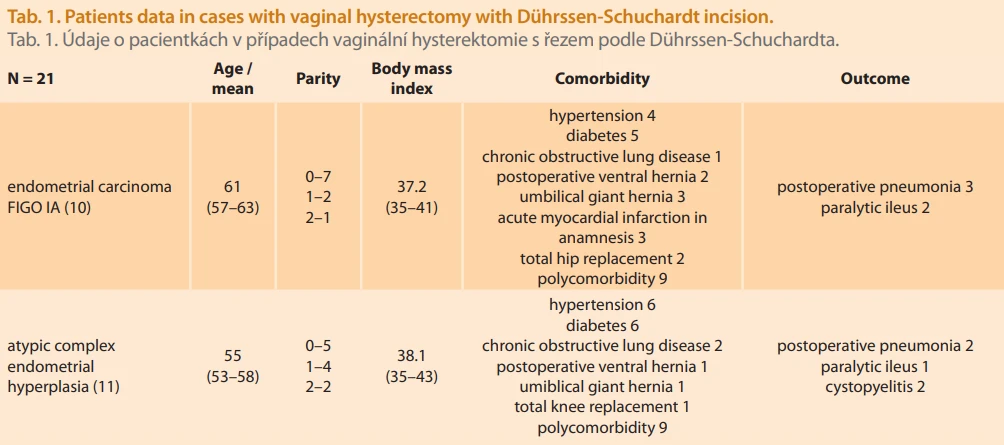
In 21 extreme overweight women, according to body mass index (BMI) mean was 37.2 in 38.1 (obese and extreme obesity – morbid obesity) in the two investigated groups, TVH was performed with facilitated access using DSI (Tab. 1) for FIGO IA endometrial carcinoma in 11 cases and atypical complex endometrial hyperplasia in 10 cases. Indications for surgery were verified by hysteroscopy or fractional curettage, and then MSCT/MRI and USG imaging did not confirm locally or systemically disseminated disease.
Results
The mean age of the patients was 61 vs. 55, with a significantly more frequent history of nulliparity in 12 vs. 9 patients. Typical comorbidities is obesity and concomitant precancers and endometrial cancer, such as hypertension, diabetes, and cardiovascular diseases, with the most common polycomorbidity and ventral/umbilical inoperable hernia and hip and knee endoprosthesis. In none of the patients was it possible to perform a laparotomic or laparoscopic procedure due to the mentioned comorbidities and polycomorbidities.
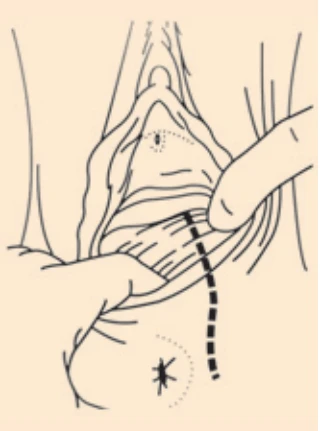
All patients were operated on under general endotracheal anesthesia. A left-sided DSI incision was made with light tamponade in the wound and the placement of a wide vaginal speculum, which ensures good access and the width of the surgical field for the width of the vagina. Then, TVH without adnexectomy was performed with electrodissection and median sacrorrhaphy. Adnexectomy was not performed in any patient due to the inability to visualize the adnexae transvaginally because extreme obesity and pelvic anatomy distorsion, as well as the unproven tumor process by preoperative imaging methods. The TVH with DSI surgical procedure lasted between 45 and 80 minutes.
Prophylactic perioperative antibiosis (and the list of comorbidities), cefazolin 2 g was prescribed, continued for five days in all patients. In cases with pneumonia and cystopyelitis, antibiosis according to the antibiogram was included (gentamicin with cefazolin). In three cases, early paralytic ileus developed, which was treated conservatively with a good outcome and the establishment of peristalsis by the 5th postoperative day. LMH prophylaxis and early mobilization were performed in all patients, and the wound was treated with local hyaluronic gel.
The urinary catheter was removed on the first postoperative day in all patients. In 11 patients, discharge from the hospital occurred on the 4th postoperative day, and in the remaining 10 patients, after resolution of postoperative complications between 8 and 14 days. There were no postoperative complications related to the surgical procedure and the surgical wound; all wounds healed per primam, and no late postoperative complications related to the surgical technique were recorded.
Discussion
In 1890, the German gynecologist and obstetrician Dührssen described an extended lateral cervicovaginal-perineal incision for obstetric operations, and Schuchardt then published his work in 1893, recommending a lateral vaginoperineal incision for vaginal hysterectomy [4,5]. Since then, DSI has been recommended for a century in extended oncogynecological vaginal surgery and laparovaginal surgery in all age groups and in patients with different body mass indices (BMI) and comorbidities that most often accompany premalignant or malignant cervical tumors [1,2,6].
However, in most of our gynecological clinics, DSI is rarely used due to the modern endoscopic approach to oncosurgery in the new millennium and is therefore rarely cited and recommended in the literature, except in gynecological surgical atlases. Ferrier et al. recently described a case of radical vaginal surgery according to Schauta-Amreich using DSI in a 56-year-old patient and recommend this approach with the suggestion of known minor postoperative complications in vaginal surgery, including in their case [6]. Likewise, morbidly obese patients are often subjected to other forms of multimodal oncogynecological therapy, most often chemoradiation and high doses of hormonal depot gestagens, due to inoperability or high-risk surgical procedures and anesthesia due to comorbidities or polycomorbidities and expected postoperative complications, which are significantly more frequent.
The surgical approach to DSI involves a monolateral, most often left-sided colpoperineotomy, which provides greater visibility and access to the anatomical structures to be prepared and/or dissected. However, for example, in nulliparous women (narrow and long vaginas), monolateral DSI may be insufficient, so bilateral DSI is recommended for better visualization. In the new millennium, electro (thermo) dissection is used in daily laparoscopic and laparotomy gynecological surgery, which is associated with significantly fewer intraoperative and postoperative complications in comparison with the classic technique of ligation of numerous sutures. In all presented cases of this material, electro (thermo) dissection was used, and no complications related to the surgical technique were recorded (possible seromas, wound inflammation, or early postoperative bleeding), so this form of dissection is certainly superior to the classic form of cutting and ligation with sutures [1,2].
In the scarce literature, there are few descriptions of postoperative complications of DSI, which are common for such extensive pelvic-perineal surgeries, and gynecological surgical textbooks mention complications that are mainly associated with polycomorbidities in extremely obese women (diabetes, immobility, thrombotic diseases), such as more frequent infections and dehiscences of the surgical wound, and late complications that are also associated with polycomorbidity [1,2,6]. Thus, we had five postoperative pneumonias, three postoperative paralytic ileus and two cystopyelitis, which are expected complications in such a high-risk patient population. In addition to the mentioned possible early and late postoperative complications, Barranger et al. recently presented a case of metastasis of neuroendocrine cervical cancer in the DSI scar [7].
Obviously, modern surgical (primarily endoscopic) technology and a medical approach to the treatment of premalignant and some malignant lesions of the female genitalia have taken precedence over classical vaginal surgery, which, despite its numerous advantages and faster recovery, has not yet taken over its former primacy in comprehensive gynecological surgery. However, the combination of the traditional vaginal approach to surgery, including DSI, with the use of electro (thermo) dissection as a modern technology of this millennium, provides even better success rates in gynecological surgery.
Perioperative and postoperative treatment is certainly necessary in terms of antibiosis, establishment of peristalsis, and antithrombotic prophylaxis with early mobilization, which is often difficult in morbidly obese patients. Therefore, this approach to TVH with the help of DSI is certainly a “minimally invasive procedure” but effective in morbidly obese patients with good early postoperative recovery and healing of DSI. The above personal results support this approach to vaginal surgery and are recommended in extreme obesity women.
Submitted/Doručeno: 30. 1. 2026
Accepted/Přijato: 13. 2. 2026
Prof. Dubravko Habek, MD, MSc, PhD., PhD
Croatian Academy of Medical Sciences
Ilica 244
10 000 Zagreb
Croatia
dhabek@unicath.hr
Zdroje
1. Hirsch HA, Käser O, Ikle FA. Atlas der gynäkologischen Operationen. Stuttgart, New York: Georg Thieme Verlag 1995 : 235–295.
2. Walwiener D, Jonat W, Kreinberg R et al. Atlas der gynäkologischen Operationen. Stuttgart, New York: Thieme Verlag 2018 : 241–285.
3. Habek D. Obstetrics operation. Zagreb: Medicinska naklada Publisher 2024.
4. Dührssen A. Über den Werth der tiefen Cervix - und Scheiden-Damm-Einschnitte in der Geburtshülfe. Arch Gynak 1890; 37 : 27–66. doi: 10.1007/BF02002221.
5. Schuchardt K. Eine neue Methode der Gerbärmutterexstirpation. Zentralbl Chir 1893; 20 : 1121–1126.
6. Ferrier C, Pellevoizin R, Touboul C et al. Back to the future: Schauta-Amreich radical vaginal hysterectomy assisted by laparoscopy with sentinel lymph node biopsy for early-stage cervical cancer. J Minim Invasive Gynecol 2021; 28 (1): 131–136. doi: 10.1016/j.jmig.2020.06.004.
7. Barranger E, Hugol D, Daraï E. Metastasis on a Schuchardt incision after Schauta-Amreich operation for cervical carcinoma. Gynecol Oncol 2004; 92 (3): 1006–1007. doi: 10.1016/j.ygyno.2003.11.042.
Štítky
Dětská gynekologie Gynekologie a porodnictví Reprodukční medicínaČlánek vyšel v časopise
Česká gynekologie
2026 Číslo 4
Nejčtenější v tomto čísle
- 150 years of the Apolinář maternity hospital in Prague – the history of one of the longest-running maternity hospitals in the world
- Comparative diagnostic accuracy of office hysteroscopy and three-dimensional transvaginal ultrasonography versus histopathology in women with abnormal uterine bleeding
- Personalized approach to infertility treatment in a patient with polyendocrine metabolic ovarian syndrome and chronic pancreatitis
- Ultrasound examination during labor – a prospective pilot comparative study of clinical and ultrasonographic accuracy